EXPLORE, LEARN, EXCEL with
The Clara James Approach
BLOG PAGE
EDUCATION
What Can I Do If I Can't Afford a Tutor Right Now?
What Can I Do If I Can't Afford a Tutor Right Now?
A parent recently emailed me to say that she had enjoyed reading Square Pegs & Round Holes but, unfortunately, couldn't afford tutoring at the moment.
She then asked a question that I suspect many parents are wondering:
"What can I do to help my child myself?"
Her son is in Year 10 and her daughter is in Year 8, so I thought I'd share some of the suggestions I gave her in case they help someone else too.
GCSE English: Focus on the Skills That Carry the Most Marks
One of the most important things students can do is become familiar with the key language techniques they are expected to recognise and use.
Things such as:
Similes
Metaphors
Alliteration
Personification
Adjectives
Adverbs
The more confident they become using these techniques in their own writing, the easier it becomes to spot them in a text and explain their effect.
For example:
"The stars were in the sky."
could become:
"The night sky sparkled with a thousand tiny diamonds."
The second sentence gives us much more to discuss.
Why did the writer choose those words?
What image do they create?
How do they make us feel?
A useful habit is to keep asking:
"Why?"
Almost like a toddler who never stops asking questions.
Why did the author choose that word?
Why did they create that image?
Why did they want the reader to feel that way?
The deeper students can go with this thinking, the stronger their analysis becomes.
Don't Forget Question 5
For many students, Question 5 on English Language Paper 1 and the writing section of Paper 2 can have a huge impact on their final grade.
These extended writing tasks carry a significant proportion of the marks available.
A simple way to practise is to find a newspaper article and rewrite it in your own words.
This develops vocabulary, sentence structure, and confidence in adapting language for different audiences.
Remember:
Letters should look like letters.
Speeches should sound like speeches.
Articles should have titles.
The examiner wants to see that students understand the purpose and format of the writing task.
GCSE Maths: Let the Past Papers Guide You
When revising maths, I often suggest using past papers as a guidance tool rather than a test.
Work through a paper.
Identify the questions you found difficult.
Then focus your revision on those topics.
There are some excellent free resources available online, including:
MME Revision
Corbett Maths
YouTube tutorials
Don't worry too much about working under timed conditions initially.
Focus on understanding the method first.
Speed can come later.
Celebrate What Is Going Well
One mistake many students make is creating a list of everything they can't do.
When you do that revision can quickly become negative.
Instead, create two lists:
Things I need to work on.
Things I already understand.
It's important to recognise how much progress has already been made.
I also encourage students to write down one thing each day that they have done towards their revision.
It doesn't need to be huge.
A practice question.
A video watched.
A page of notes completed.
Something they better understand.
Over time those small actions add up and provide a useful reminder of how far they have come.
Creative Writing: Build a Library of Ideas
For younger students who struggle with creative writing, I often suggest starting with a picture or a simple scenario.
Before writing anything, spend a few minutes collecting ideas.
Think of:
Similes
Metaphors
Adjectives
Interesting vocabulary
You don't need to use them all.
The goal is simply to build a bank of ideas before facing the blank page. Some ideas can be fairly generic but adapted and used time and time again.
For example:
"The sky was an artist's palette."
Or
"The sea was an artist's palette."
Or
"The sunset was an artist's palette."
Having a collection of phrases ready often helps students get started more confidently.
A Final Thought
If I could offer one piece of advice, it would be this:
Don't try to fix everything at once. We can't prioritise everything.
Choose one area.
Work on it consistently.
Celebrate the small wins.
Confidence grows surprisingly quickly when children can see their own progress.
And sometimes that confidence is every bit as important as the knowledge itself.
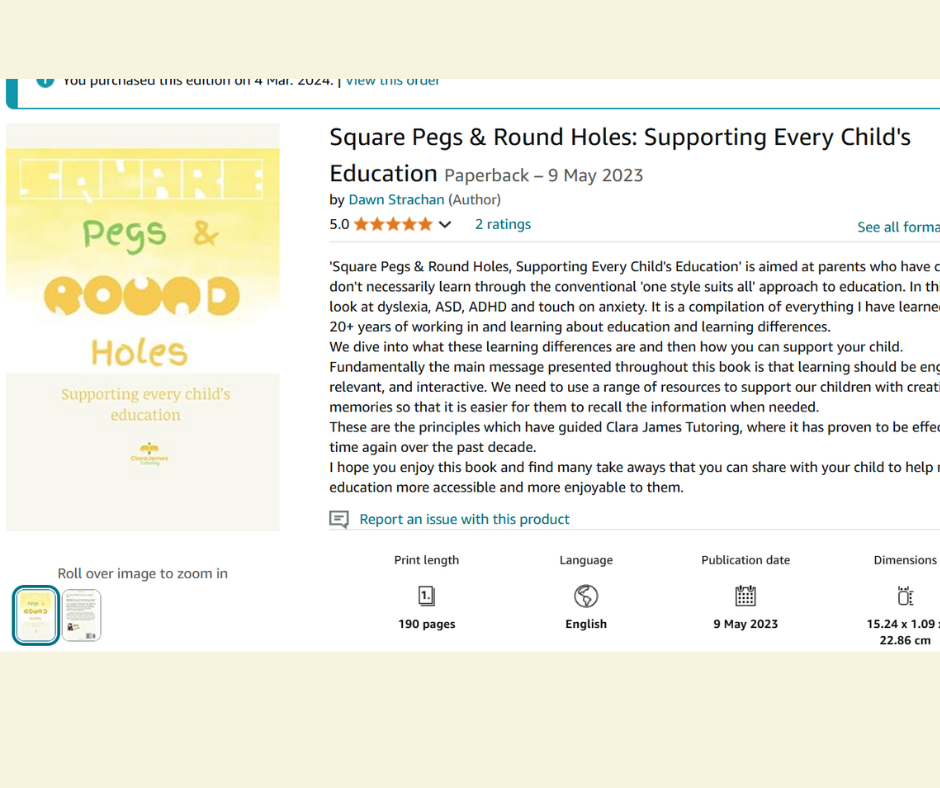
If you would like a free copy of my book "Square Pegs and Round Holes: Supporting Every Child's Education" please do get in touch and let me know. There's no strings, it's just a gift from me to you.
It focuses on how we learn and ways that we can support our children.

Stay Connected with Our Latest Stories and Updates!
Explore our blog for insightful articles, tips, and news to inspire and inform.
Whether you're seeking practical advice or simply a good read, our blog has something for everyone. Don't miss out on our fresh contents!
© Copyright 2022 The Clara James Approach