“I Hate Reading!”
I have 3 children. Clara is now nearly 30 and apart from the books she has read to her little lad has barely read a book since primary school. Then there are Jamie and Angel who (Angel especially) are book worms, they would often be found with their heads buried in a book. In fact, the Clara James logo is an angel reading a book, although I didn’t design it, when it came through it seemed very appropriate.
So, why do some people love reading whilst for others, even just the prospect of it makes their blood run cold…
Generally speaking, it’s rarely just about not liking books, there’s usually a deeper reason and the word “Hate” can be a cover for feeling overwhelmed, embarrassed, or bored especially in a day and age when information and entertainment is so readily available at pace.
From people like myself, who enjoy finding the time to get engrossed in a book, it can sound judgemental when you ask why they don’t enjoy it, but try not to judge, try to be open and understanding.
When many children go into key stage 3 there is a huge jump in expectations from the teacher and the school and for many children this can quickly dent any confidence or enthusiasm that they did have.
If you'd rather watch the video than read the text, watch here
Is It the Book, the Task, or the Struggle?
Sometimes it’s not necessarily the act of reading that they dislike, rather the fact that they are yet to find something that they enjoy reading. There is this perceived idea that we should read formal books, maybe something that is rich in culture! Yet reading is reading, whether it is a magazine article, instructions for a game, or something completely different the form it is presented in is generally of irrelevance. Some children dislike what they’re asked to read simply because it seems old-fashioned, or they just can’t relate to it.
Others enjoy stories but struggle with reading aloud, comprehension, or the pressure of worksheets. I can remember when I was at school, and many others have agreed since, when the teacher decides to go around the classroom asking people to read out in turn, the fear of reading in front of everyone else just turns your brain to putty. You focus on what you might end up reading rather than listening to what is happening in the text prior to this point. It gets to your turn, your mouth goes dry, the words on the page now look like a foreign language, your cheeks go the colour of beetroot, and someone steels your voice so that all you can manage is a small squeak and the fear of crying at this public humiliation.
Others can read the words but struggle to recall what has been said making responding to the questions asked a new nightmare that you have unexpectedly been hurled into with no escape.
Try to figure out which bit feels hard: the reading itself, the school tasks, or the emotional response. If you can show empathy, let them know that they are not alone in this struggle and turmoil.
For some parents the attraction of home-schooling is not having to follow rigid curriculum which hasn’t proven to be appropriate for their child.
Spotting the Hidden Barriers
Struggling with reading doesn’t always mean “lazy” or “unmotivated” there could be multiple reasons why someone doesn’t enjoy reading such as dyslexia, ADHD, poor working memory, slow processing, or eye tracking issues?
When my oldest went into the juniors I approached her school and asked if they agreed that she could be mildly dyslexic. There response was: “Dyslexia is just an excuse for laziness.” Thankfully attitudes are changing, but this is why I set about learning as much as I could about different learning styles and neurodiversity.
When your child is reading do look for signs like skipping lines, guessing words, tiredness when reading, or poor spelling. They are not conclusive, but they may be indicators that you want to follow up. Trust your instincts, if something feels off, it generally is worth exploring further.
4. Why Reading Feels So Different in KS3
The step into ks3 feels like such a leap. It is suddenly, not just what they read but how deeply they’re expected to understand it. Reading is now not just an act in itself, it is an entrance to a whole new world of expectations!
The focus moves from being able to decipher and enjoy the words to focusing on analysis or inference, “writer’s intentions” both of which are abstract and tricky for literal or concrete thinkers.
Furthermore, less time is spent reading aloud or enjoying stories just for the fun of it in school.
5. How to Rebuild a Positive Relationship with Reading
I think the first thing we need to do is to take the pressure off, we don’t need to set a minimum number of pages or a certain length of time. We don’t need to test them on what they’ve read, just let them enjoy the book for what it is. I think we are the same as adults, as soon as we are told to do something the enthusiasm for it evaporates, however if we think we are doing it through choice, we are far keener to participate.
Encourage them to choose their own books, even if they may not be what you would have chosen for them to read. It doesn’t even need to be a formal book; reading is reading and if they are at least reading something – embrace it!
We often play the dotty board game. I created it years back when I first started tutoring.
You have a page of A4 paper and around the edge/ across the middle we have 6 yellow dots, 6 blue dots, 6 green dots. You can be green, I’ll be yellow.
You roll the dice and that determines how far you can move. You can go in any direction, but you can’t change direction halfway through a go. If your counter lands on a green, you will need to read a sentence, paragraph, page, or whatever we deem to be appropriate. If anyone lands on a yellow, I’ll have to read.
If someone lands on a blue, they roll the dice again and there is a selection of forfeits which are determined by the number on the dice:
1) have another go
2) go forward 3 spaces
3) go back 6 spaces
4) miss a turn
5) the other person reads
6) you need to read again
I think the first thing we need to do is to take the pressure off, we don’t need to set a minimum number of pages or a certain length of time
The goal when I came up with this was to take the onus off one person having to put in all the effort as I knew as a child how I used to hate reading out. In my head, no problem. As soon as I started reading out loud, I became a bumbling buffoon. I also felt that if you never knew when your turn was coming it would mean in you had less of an opportunity to sit there in dread because you would also become too caught up in the game.
When they read try to just listen and not correct them. Celebrate their effort not the outcome and praise them when they are able to recognise words that they hadn’t recognised previously.
6. Alternative Ways to Develop Reading Skills
Reading traditional books isn’t necessarily the only route to reading and getting engrossed in the content of a good book. Audiobooks aren’t “cheating”, they are a brilliant way to support comprehension and vocabulary with far less pressure. It might also be worth offering graphic novels, magazines, and even game guides as reading materials, as it all counts as real reading.
Many people enhance their reading skills by having the subtitles on when they are watching TV or by Participating in read-along books.
I can remember as kids mum and dad would generally get me something to keep me occupied on Christmas Eve. It would take the form of a magazine or colouring book. (I did the same with my three when they were young- getting them to create simple place markers for the Christmas table). But one of the magazines they got me was a read-along one with a tape cassette attached. I can still remember the stories now, it was called “What Wanda Wants” and it was read by Bernard Cribbins. I love books, I love reading, but that story and him reading it has stayed with me far longer than any other book I have ever read.
Build on what they love, whether that be Minecraft books, sports bios, humour books, etc. I decided at a young age I was going to work with animals (a dream I still have) so I read every single animal book in the local library. Then I decided to become a criminologist (A dream I no longer have), so I set about reading all the true crime books. Had I have been told to read books that didn’t interest me, I probably would never have read as much as I did, but with the encouragement of mum, dad and the librarians, I loved it, the library became like a second home.
7. When and How to Step In
When you are reading try to make it fun. Your support is important, but so is giving space. If you find you are correcting every word, they will quickly loose confidence and the story will have less of a flow, making it seem more disjointed and less enjoyable. In turn creating a bigger challenge, a bigger mountain to climb.
Try to find times when the house is calm, offer help when it is needed, or like mentioned previously try to find things that can be read that are presented in a “friendlier” format: dyslexic friendly, bigger font, images and colour.
Offer praise and encouragement. A lot of kids won’t accept it from their parents: “you’re obliged to say that you’re my mum, dad, aunt, uncle, etc…” but be genuine with it and they will learn to realise that you are sincere and that your words come from the heart.
Don’t mock them in gest, because although you know those words are only meant as a joke, they often cut deep.
If school demands feel too much, speak to teachers about adapting the workload. Read together, work together. Be a team.
Many children find their reading groove later than others. Mum was an adult before she started to enjoy reading and by the end of her life, she was taking pleasure from reading every day. It genuinely is never too late to start. As in many things, progress often starts with confidence rather than endless correction. Find moments where you can laugh together, but remember, please don’t laugh at them. Rebuild reading experiences into something positive.
Learn and grow together. Work as a team. Offer confidence and love. Like with many things, it might take time, but if time offers a lifelong love of reading, it was time well spent.
What’s next?
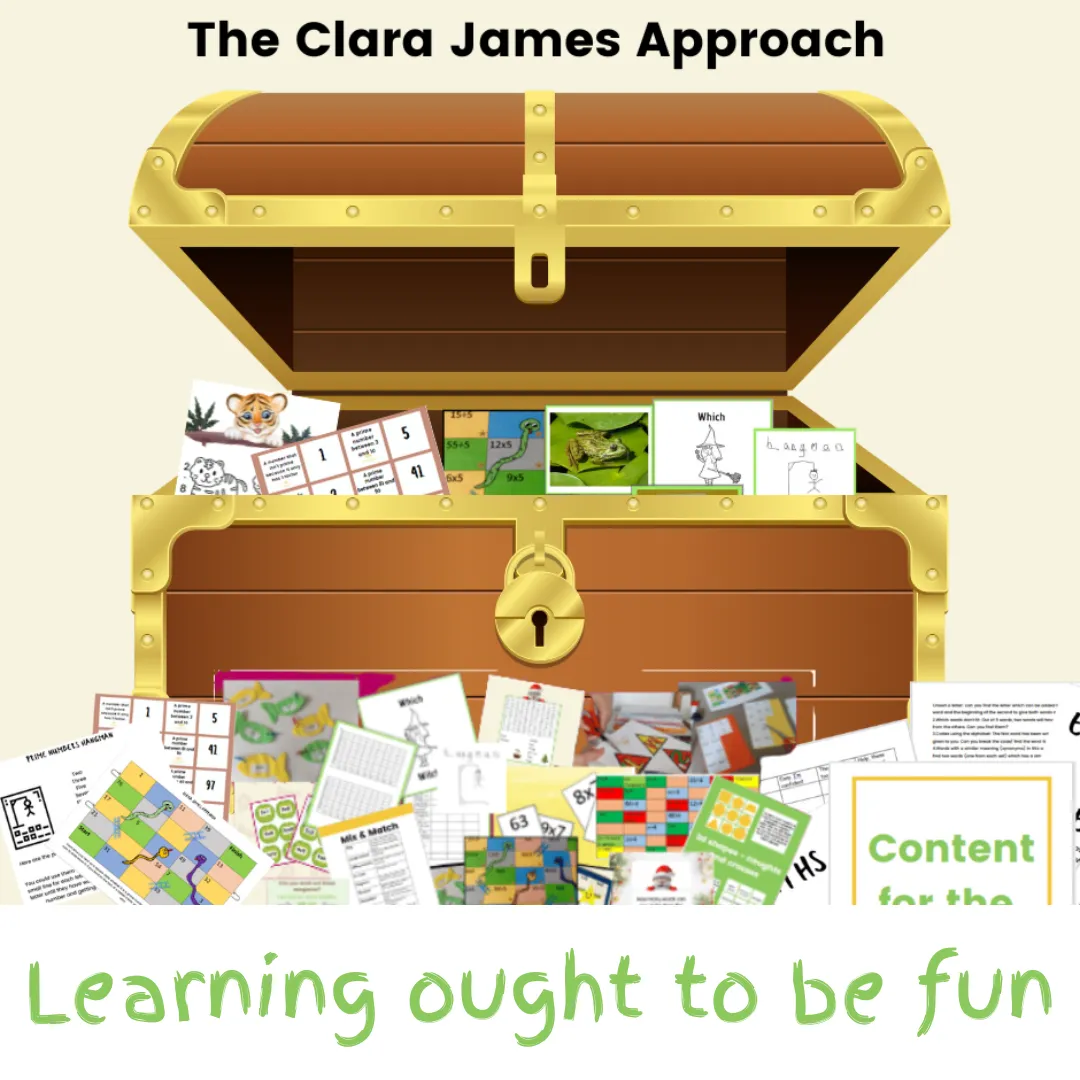
We have a membership group (The Clara James Approach) which contains activities to compliment different books.
The goal being to celebrate what they are reading and build comprehension in a fun and creative way. If you would like to learn more about it, click on the link below
Copywrite: Clara James Tutoring 2025